Rhino camp is a refugee settlement in Arua district that opened in 1980 and is home to many refugees. The camp was expanded in the wake of the South Sudanese civil war and hosts a sudden influx of refugees in the north western part of Uganda. In 2018, the refugee settlement had more than 116,000 refugees, who were mostly South Sudanese, and has continued to receive new arrivals. In August 2017, “the settlement was expanded with the establishment of the Omugo zone extension area,” according to the Uganda Refugee Response Monitoring Settlement Fact Sheet: Rhino Camp (January 2018).
The camp Refugee settlement has seven zones– Ofua Zone, Omugo Zone, Ocea Zone, Odobu Zone, Siripi Zone, Tika Zone and Eden Zone. The refugee settlement is not only home to refugees but also to many vulnerable or/and marginalized groups such as aged persons, children, Persons with Disabilities (PWDs), and women with diversity of languages spoken with the main one spoken—English.
As a result of the camp with many people from different countries, different developmental organizations, companies and individuals have worked entirely hard to set up schools, community organizations, health centers, community learning centers, electricity and water resources to support the community of refugees and their growth. However, most of these information are not available or limited on Wikipedia. Yet, the refugees are in a better position to document the information, although they lack the skills required to edit and create articles on Wikipedia.
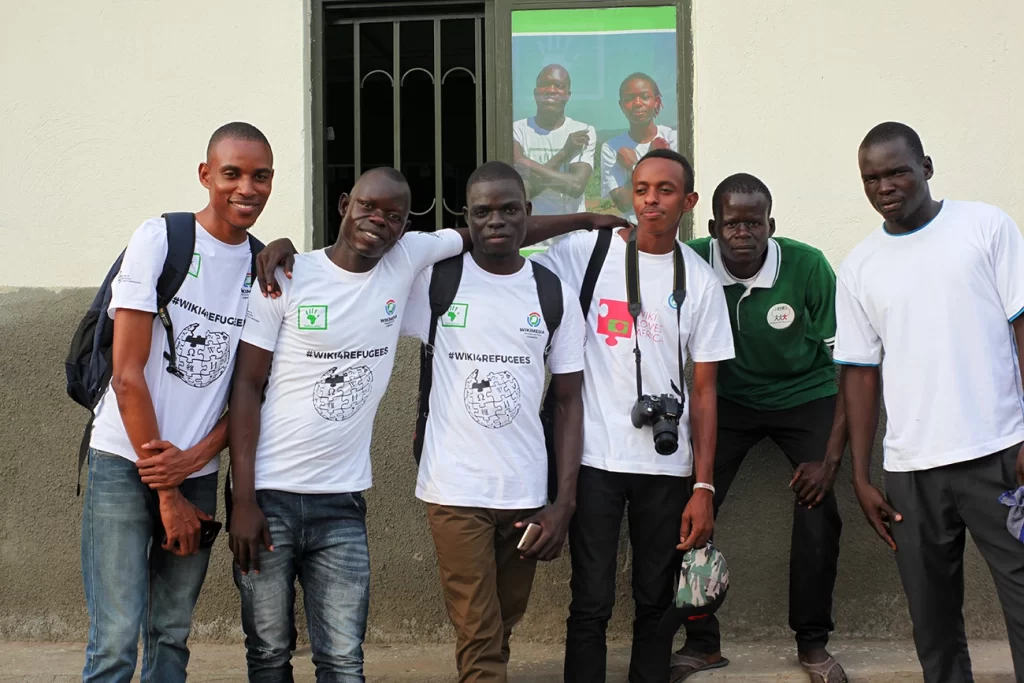
In February,2020, Platform Africa-Uganda– a Non-Profit Community Based Organization Registered with the Arua Local Government Directorate of community services located in Ocea Zone in partnership with the Wikimedia community User Group organization and Community Development Centre (CDC), came together as implementing partners and organized a two days #Wiki4Refugees Edit-a-thon in Ocea Zone, Rhino to train the refugees community on how to create articles on Wikipedia. Participants were trained on how to create WikiData items on Wikipedia and how to create images, and videos on Wikimedia commons as well. The event which took place between February 22 and 23, 2020, was to increase access to credible up-to-date information on refugees in Rhino Camp on Wikipedia.
Rhino camp refugee settlement being the second-largest refugee settlement in the northern region of Uganda from South Sudan, the Democratic Republic of Congo, Burundi, Rwanda, and Kenya. Vulnerable groups are faced with intricate challenges but also possess unique potential and innovations that could be reflected to inspire pride and empower local actions. The camp receives assistance from numerous non-governmental organizations and 20 community-based organizations – both operating and implementing partners hold so much information about refugees but other stakeholders and researchers have either limited or completely no access to consume. This unreliability in accessing the information on refugees could potentially deter many opportunities but also shape how refugees are perceived since many of the articles/stories are created by outsiders.
Geoffrey Kateregga, a volunteer at the Wikimedia Community User group who was the lead facilitator during the two days training said that #Wiki4Refugees Editathon Sprint was an initiative of Platform Africa and the Wikimedia User Group in Uganda which aimed at gathering diverse stakeholders from Refugee Settlements in Uganda to co-create and collectively improve information about Refugee Settlements on Wikipedia– the world’s largest collaborative knowledge base.
Kateregga told the editathon participants that the two days program will be divided into three parts which included;
- Intensive training: Participants were introduced to key skills and tools on how to update/ edit and add articles to Wikipedia for the event.
- Edit-a-thon – This was dedicated to the second day of the program aimed at improving stub articles and creating new entries about critical topics, underrepresented groups, initiatives, and putting up-to-date figures about refugees, etc.
- Creating content for upload on Wikimedia Commons including videos, audios and videos to document the life of refugees in Uganda.
On day two of the training, most of the participants who participated in creating articles and wikidata items on refugee settlements in Rhino camp also went for a photo hunt and images were uploaded on Wikimedia commons.
At the end of the two days Wiki4Refugees edit-a-thon– five(5) articles were created, 16 articles were edited, 122 total edits were made, 8.55 words were added, 25 references were added, 1.66 articles were viewed, 8 commons uploads were made with a total of 14 editors who participated and contributed to the event. Click event dashboard for details: https://outreachdashboard.wmflabs.org/courses/Wikimedia_Community_User_Group_Uganda/Wiki4Refugees_Uganda_(February_2020)
Participants from the Rhino refugee settlement also continued to participate in different Wikimedia Community User group projects such as Wiki Loves Africa and WikiGap editathon (Wiki Loves Women) competition.
Romeo…who is the program manager of Platform Africa, Uganda and a refugee at Rhino camp participated in the WikiGap competition in the month of March and April,2020 and took the fourth position with …articles.
Speaking to Romeo, he told the User group what inspired him to participate in the competition. “I..,” said Romeo.
This event not only improved the skills of the participants, but it also offered an opportunity for the participants to develop their capacity, improve access to enormous accurate information about refugees and organizations to people within the settlement and beyond.
We all might know that Information plays an important role in our day to day life – It builds well-informed communities while facilitating research and enabling aid workers, students and other stakeholders pinpoint existent statistics, languages, demographics, and issues of concern in their response and reports, however, despite the huge influx of refugees to Uganda, the representation of refugees on sites like Wikipedia is very inadequate.
Rhino camp had only a two-liner stub article on Wikipedia yet there is immense data pertaining to the hosting community, innovative initiatives working with refugees, the progressive Uganda refugee act 2006 and how it supports refugees, and gaps in the refugee camp that could be collectively improved.
Wikipedia is not only the most trusted, open and collaborative knowledge base but also the tenth most visited site in the world. With the #Wiki4Refugees program, it brought together different stakeholders from the refugee camp to collaboratively co-create information about Rhino Camp refugee settlement and feed it as entries to Wikipedia.
After the two days activity, which was attended by empowered Community Based Organizations, Civil Society Organizations and other organizations, they were able to gain knowledge about editing content online about Rhino Camp. This created an informed community of organizations to update information about Rhino Camp and other Wikipedia initiatives.